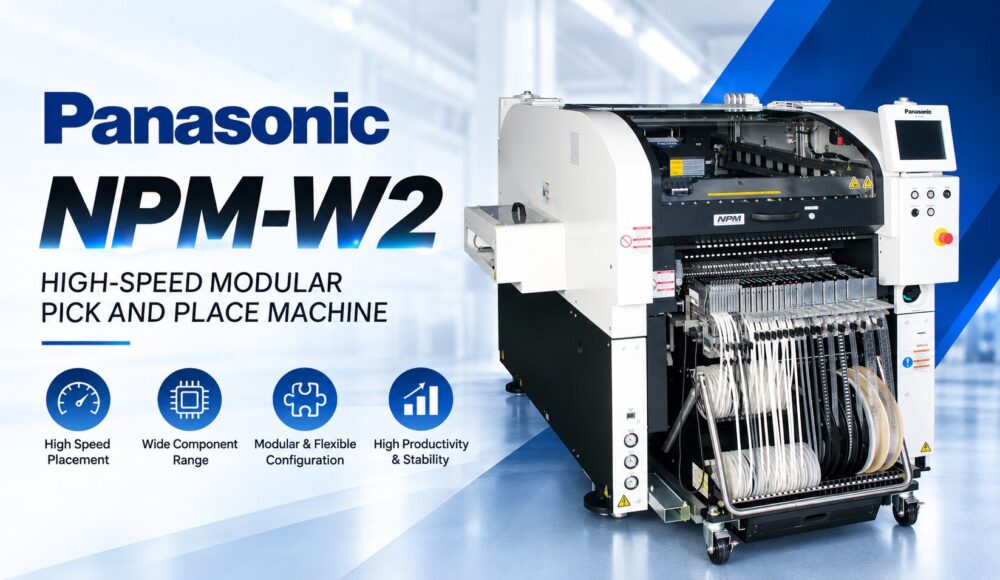
Electronics manufacturers increasingly need SMT equipment that can handle frequent product changeovers, a wide component mix, and different PCB sizes without requiring a long or overly specialized production line. The Panasonic NPM-W2 was developed for this kind of flexible manufacturing environment.
The NPM-W2 is a two-head modular SMT mounter that combines high-speed chip placement with support for larger components, large PCBs, single- or dual-lane production, and several component supply methods. Its modular design allows manufacturers to select the head, conveyor, feeder, tray, inspection, and dispensing configuration that best fits their production requirements.
For factories evaluating a new or used Panasonic pick-and-place machine, the NPM-W2 remains a practical platform for high-mix PCB assembly. View the Panasonic NPM-W2 Production Modular Chip Mounter for available machine information and purchasing support.
What Is the Panasonic NPM-W2?
The Panasonic NPM-W2, model NM-EJM7D, is a modular component placement machine designed around two configurable heads. Depending on the production target, the machine can use 16-nozzle, 8-nozzle, or 3-nozzle placement heads. Inspection and dispensing heads are also available for compatible configurations.
This flexibility allows the NPM-W2 to cover more than one role in an SMT line. A configuration using lightweight 16-nozzle heads can prioritize chip-placement productivity, while 8-nozzle or 3-nozzle heads can expand the supported component range and handle larger or more complex packages.
The machine supports tape, stick, and tray components, making it suitable for consumer electronics, automotive assemblies, industrial controls, communication products, server hardware, and other high-mix applications.
Key Panasonic NPM-W2 Specifications
| Item | NPM-W2 Specification |
|---|---|
| Machine model | NM-EJM7D |
| Number of heads | 2 |
| Supported placement heads | 16-nozzle, 8-nozzle, and 3-nozzle heads |
| Maximum placement speed | Up to 42,000 CPH under optimum conditions |
| Placement accuracy | Up to +/-30 micrometers, Cpk >= 1, depending on head and mode |
| Component range | From 03015 chips to components up to L120 x W90 x T30/T40 mm, or L150 x W25 x T30/T40 mm, depending on configuration |
| Maximum single-conveyor PCB size | L750 x W550 mm in batch mounting mode |
| Maximum dual-transfer PCB size | L750 x W260 mm in batch mounting mode |
| PCB transfer | Single or dual lane |
| Component supply | Tape, stick, and tray |
| Maximum tape component capacity | Up to 120 positions using 4 mm or 8 mm tape calculation |
| Electrical supply | 3-phase AC 200/220/380/400/420/480 V, 2.8 kVA |
| Pneumatic supply | 0.5 MPa, 200 L/min (A.N.R.) |
| Machine dimensions | W1,280 x D2,465 x H1,444 mm in the standard ITF-cart configuration |
| Approximate mass | About 2,850 kg in the standard ITF-cart configuration |
Published values are based on Panasonic’s specified conditions. Actual performance and capability depend on the installed heads, feeder system, conveyor, software, options, component data, and production conditions.
Configurable Placement Heads for Different Products
The ability to combine different head types is one of the NPM-W2’s most useful characteristics. The lightweight 16-nozzle head is intended for high-speed placement of smaller components and can reach a published maximum of 42,000 CPH per head in high-production mode under optimum conditions.
The 8-nozzle head extends the supported component range while maintaining productive placement performance. The 3-nozzle head is designed for larger, taller, or more complex components that require different recognition and handling capabilities.
Because the machine has two head positions, users can configure both sides for similar work or combine head types to balance chip speed and component flexibility. The correct choice depends on the bill of materials, package sizes, feeder requirements, and target cycle time.
Support for Large PCBs and a Broad Component Range
In a single-conveyor batch-mounting configuration, the NPM-W2 can process PCBs up to 750 x 550 mm. This is useful for industrial control boards, power electronics, communication equipment, LED products, and other assemblies that exceed conventional PCB dimensions.
Component capability also changes with the selected head. Panasonic’s published specifications cover components from 03015 chips up to L120 x W90 x T30/T40 mm, or long components up to L150 x W25 x T30/T40 mm. Large-component and increased-height capabilities may require the appropriate head, nozzle, camera, and optional configuration.
When selecting a machine, buyers should compare the actual PCB dimensions and complete component list with the installed configuration rather than relying only on the model name.
Single- and Dual-Lane Production
The NPM-W2 supports both single- and dual-lane PCB transfer. A single-lane configuration provides greater board-width capability, while a dual-lane arrangement can improve line utilization when two products, two board flows, or balanced upstream and downstream processes are required.
Panasonic also provides different placement modes for suitable configurations, including independent, alternate, and hybrid production. These options help factories adapt the machine to board size, takt time, and line-balance requirements.
Dual-lane production does not automatically guarantee higher output in every application. The practical gain depends on PCB dimensions, placement density, feeder setup, product changeover frequency, and the performance of surrounding equipment.
Flexible Component Supply and Changeover
The NPM-W2 supports taped, stick-fed, and tray-fed components. Tape feeders are available across multiple widths, while feeder carts and tray systems can be selected according to the component mix.
The maximum tape component capacity is up to 120 positions when calculated with 4 mm or 8 mm tape. Actual capacity varies with tape width, feeder type, cart configuration, and the use of tray or stick feeders.
For high-mix factories, feeder preparation and changeover time can be as important as placement speed. Panasonic offers setup-support and automation functions for compatible machine generations and software environments. Buyers of used equipment should confirm which feeder system, carts, licenses, and automation options are included with the individual machine.
Placement, Inspection, and Process Integration
Compatible NPM-W2 configurations can combine placement with inspection or adhesive dispensing functions. Panasonic’s process-control ecosystem can also exchange data with SPI and AOI equipment to support correction and quality control.
These capabilities can be valuable when a line needs stronger traceability or process feedback. However, inspection heads, dispensing heads, process-control functions, and software packages are configuration-dependent. They should be verified individually when evaluating a machine.
For many buyers, the main value of the NPM-W2 remains its modularity: the same platform can be configured for chip-intensive production, mixed-component placement, large boards, tray components, or a combination of these requirements.
Why Consider a Used Panasonic NPM-W2?
A used Panasonic NPM-W2 can provide a cost-effective route to expanding SMT capacity, replacing an older placement platform, or adding flexibility for new products. It may also fit factories that already use compatible Panasonic feeders, nozzles, software, or line equipment.
The purchase decision should be based on the complete machine configuration and verified operating condition. Two NPM-W2 machines can have significantly different capabilities because of their head types, conveyor systems, feeder interfaces, cameras, software versions, and included accessories.
What to Check Before Purchasing an NPM-W2
Before selecting a new or used NPM-W2, confirm the following points:
- Complete model number, production year, and installed software version
- Front and rear head types and the supported component range
- Camera, recognition, inspection, and dispensing configuration
- Single- or dual-lane conveyor setup and supported PCB dimensions
- Feeder cart type, feeder quantity, tray units, and stick-feeder compatibility
- Included nozzles and support for the required package list
- Machine power-on, axis movement, conveyor transfer, recognition, and placement tests
- Calibration status and placement-accuracy verification
- Required electrical and pneumatic utilities at the installation site
- Export packaging, loading, installation, training, and technical-support arrangements
Confirming these items before shipment helps ensure that the machine matches the intended product rather than simply matching the NPM-W2 model name.
Is the Panasonic NPM-W2 Right for Your SMT Line?
The Panasonic NPM-W2 is well suited to manufacturers that need a balance of placement speed, component flexibility, large-board support, and configurable production flow. Its two-head architecture, maximum published speed of 42,000 CPH, single- or dual-lane transfer, and support for tape, stick, and tray components make it a versatile option for high-mix SMT manufacturing.
The final configuration should always be selected around the actual PCB, component list, output target, and available line equipment. SMTSTOCK supplies original new and used Panasonic SMT machines for customers worldwide. Visit the Panasonic NPM-W2 NM-EJM7D product page to review product information and discuss the configuration required for your production line.